
Microlearning in Distance Robotics Education: Evidence from an Undergraduate Engineering Course
DOI:
https://doi.org/10.32870/ap.v18n2.2898Palavras-chave:
Microlearning, Distance learning, Robotics education, Academic performanceResumo
This study analyzes the relationship between the use of microlearning and students’ performance in an undergraduate robotics course delivered via distance learning. A total of 35 engineering students, enrolled in two pre-existing class groups, received the same theoretical and practical content on forward kinematics and the Denavit– Hartenberg method. Group A had access to complete recorded online sessions, whereas Group B worked with a microlearning-based instructional strategy that combined short videos focused on specific concepts and procedures with embedded reflection questions, focused synchronous discussions, and guided practice. Both groups also participated in synchronous sessions and practical activities supported by 3D simulations. At the end of the intervention, students completed the same remote assessment. The results showed that the group exposed to the microlearning-based strategy achieved higher performance in the overall exam, as well as in the theory and exercises sections, with large effect sizes. These findings suggest that organizing video-based content into short, focused instructional units is associated with better learning outcomes in distance robotics education, although the quasi-experimental design does not allow firm causal conclusions
Referências
Bower, M., Design of Technology-Enhanced Learning. Emerald Insight. https://doi.org/10.1108/9781787141827, (2017).
Buhu, A., & Buhu, L., The applications of microlearning in higher education in textiles. Proceedings of the International Scientific Conference eLearning and Software for Education. https://doi.org/10.12753/2066-026X-19-189, (2019).
Craig, J. J., Introduction to Robotics: Mechanics and Control. Pearson Education, (2009).
De Gagne, J. C., Park, H. K., Hall, K., Woodward, A., Yamane, S., & Kim, S. S., Microlearning in health professions education: Scoping review. JMIR Medical Education, 5(2). https://doi.org/10.2196/13997, (2019).
Denavit, J., & Hartenberg, R. S., A kinematic notation for lower-pair mechanisms based on matrices. Transactions of the ASME, Journal of Applied Mechanics, 22(2), 215–221, (1965).
Edge, D., Searle, E., Chiu, K., Zhao, J., & Landay, J. A., MicroMandarin: Mobile language learning in context. Proceedings of the SIGCHI Conference on Human Factors in Computing Systems. https://doi.org/10.1145/1978942.1979413, (2011).
Gabrielli, S., Kimani, S., & Catarci, T., The design of microlearning experiences: A research agenda. Proceedings of Microlearning Conference 2005: Learning and Working in New Media, (2006).
Giurgiu, L., Microlearning: An evolving e-learning trend. Scientific Bulletin, 22(1), 18–23. https://doi.org/10.1515/bsaft-2017-0003, (2017).
González-García, S., Rodríguez-Arce, J., Loreto-Gómez, G., & Montaño-Serrano, V. M., Designing a teaching guide for the use of simulations in undergraduate robotics courses: A pilot study. International Journal on Interactive Design and Manufacturing, 13(3), 923–933. https://doi.org/10.1007/s12008-019-00551-0, (2019).
González-García, S., Rodríguez-Arce, J., Loreto-Gómez, G., & Montaño-Serrano, V. M., Teaching forward kinematics in a robotics course using simulations: Transfer to a real-world context using LEGO Mindstorms. International Journal on Interactive Design and Manufacturing. https://doi.org/10.1007/s12008-020-00670-z, (2020).
Harrison, T., How distance education students perceive the impact of teaching videos on their learning. Open Learning: The Journal of Open, Distance and e-Learning. https://doi.org/10.1080/02680513.2019.1702518, (2020).
Jomah, O., Masoud, A. K., Kishore, X. P., & Aurelia, S., Micro learning: A modernized education system, (2016).
Leong, K., Sung, A., Au, D., & Blanchard, C., A review of the trend of microlearning. Journal of Work-Applied Management, 13(1). https://doi.org/10.1108/JWAM-10-2020-0044, (2021).
Loreto-Gómez, G., Rodríguez-Arce, J., González-García, S., & Montaño-Serrano, V. M., Analysing the effect of the use of 3D simulations on the performance of engineering students in a robotics course: Findings from a pilot study. International Journal of Electrical Engineering Education. https://doi.org/10.1177/0020720918790113, (2018).
Rackaway, C., & Chapman, Video killed the textbook star? Use of multimedia supplements to enhance student learning. APSA 2010 Teaching & Learning Conference. https://doi.org/10.2139/ssrn.1547142, (2010).
Mohammed, G. S., Wakil, K., & Nawroly, S., The effectiveness of microlearning to improve students’ learning ability. International Journal of Educational Research Review, 3, 32–38. https://doi.org/10.24331/ijere.415824, (2018).
UNESCO, N. U. C., Education in the Time of COVID-19. ECLAC, UNESCO, (2020).
Yildirim, E., Perspective on the pros and cons of microlearning in health education. Essays in Biochemistry, 66(1). https://doi.org/10.1042/EBC20210047.
Yin, J., Goh, T.-T., Yang, B., & Xiaobin, Y., Conversation technology with micro-learning: The impact of chatbot-based learning on students’ learning motivation and performance. Journal of Educational Computing Research, 59(1), 154–177. https://doi.org/10.1177/0735633120952067, (2021).
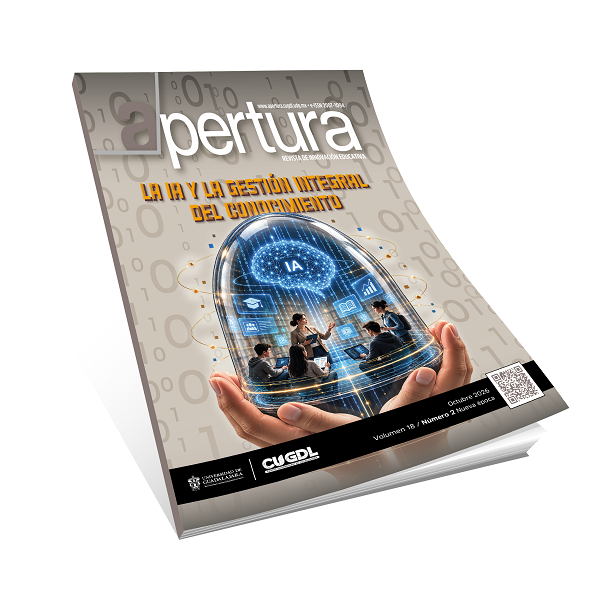
Downloads
Publicado
Edição
Seção
Licença
Os direitos autorais pertencem aos autores do texto. Caso o manuscrito seja aceito para publicação, o Sistema de Universidad Virtual da Universidad de Guadalajara (UDGVirtual) está autorizado a modificar o texto na correção de estilo, traduzir, corrigir, divulgar, reproduzir, publicar e comercializar com este. Da mesma forma, a Universidad de Guadalajara está autorizada a realizar o acima descrito em conjunto ou por meio de possíveis terceiros. (Veja a autorização detalhada na carta de direitos autorais.)
Os autores garantem à revista Apertura o direito de ser o primeiro meio de publicação da obra. É autorizada a reprodução dos textos publicados na revista Apertura, no todo ou em parte, desde que sem fins lucrativos, citada a fonte e não modificados o conteúdo ou design. Os autores podem distribuir exclusivamente a versão editorial final ou postprint em qualquer meio e a qualquer momento.
Apertura, seus editores e UDGVirtual se dissociam das informações prestadas por colaboradores ou anunciantes. Os artigos dos colaboradores não representam necessariamente o ponto de vista do editor ou da UDGVirtual e o conteúdo dos anúncios são de responsabilidade exclusiva dos contratantes.
Apertura está registrada no Instituto Nacional de Direitos Autorais com o número ISSN: 1665-6180 (versão impressa) e e-ISSN 2007-1094 (versão eletrônica), e com o Certificado de Reserva de Direitos de Uso Exclusivo do Título: 04 -2005-120212472000-102.
Também é certificado pela Comissão de Qualificação para Publicações Ilustradas e Revistas do Ministério do Interior com os Certificados Licenciados de número de título: 13449; e legalidade do conteúdo: 11022.
